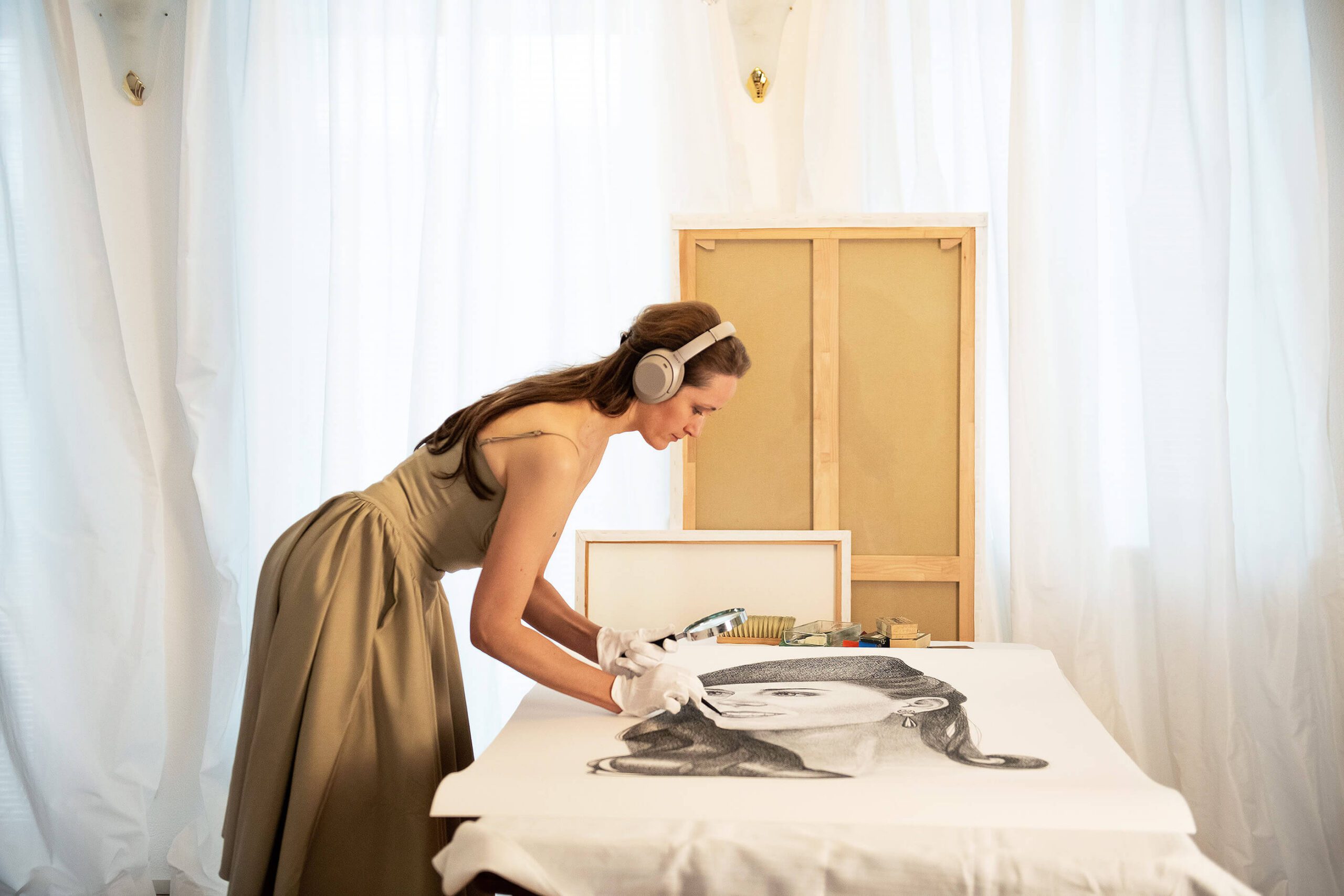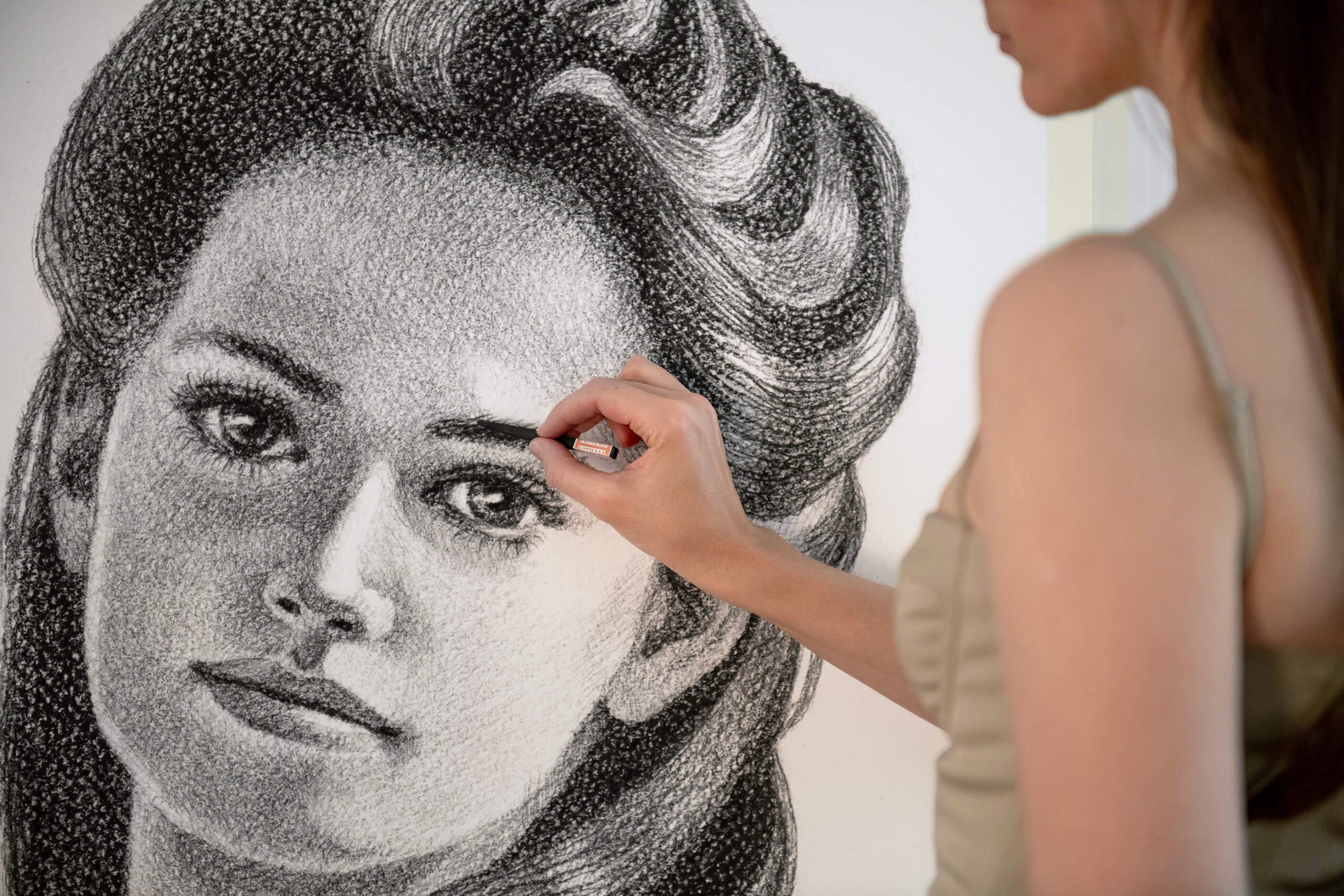


Archetype Archives is an ongoing photographic portrait series by Atlanta Weiss, exploring identity through gesture, dress and recurring symbolic figures. This essay traces its beginnings in a childhood across three countries, its first studio encounters in Cologne and the gradual emergence of its visual language.
Archetype Archives began long before I had a name for it. It began with faces.
I have always been drawn to faces, because I could not stop reading them. A face has never felt like a surface to me. It has always felt like a threshold: between what someone shows and what they carry, between the life they have lived and the life that is still waiting inside them.
By the age of twelve, I had lived in three countries with my artist family.
That sentence can sound beautiful from the outside. It suggests movement, culture, art, languages, and new beginnings. And all of that was true. But it was also difficult. Every new country meant beginning again: new schools, new rooms, new streets, new rules, new codes of belonging.
Language was often the hardest part.
When you cannot yet understand every word, you learn to read everything else. You learn the tension in a mouth, the hesitation in a hand, the way someone turns away before they say no, the kindness behind silence, the impatience behind politeness, the sadness behind competence. You learn to understand atmosphere before grammar.
I learned to read faces before I could trust words.
Reading faces before understanding words
There was a time in my teenage years when I remember wondering why people talked so much.
Why so many words? Why so much explanation? Why say everything out loud when so much was already visible?
At the time, I thought everyone could do this. I thought everyone could understand what someone was thinking by the smallest change in their expression. I thought everyone could sense what a person had experienced, what they were protecting, what they desired, what they feared, and which part of them was trying to come forward.
Only later did I realise this was not ordinary – how much attention I had learned to give to expression.
A fleeting glance could stay with me longer than a conversation. Sometimes I receive images about the person before the other person has confirmed it, before the feeling has become visible, before there is proof. An impression can be formed before I had the words—or the evidence—to explain it.
This sounds strange. But it is also my strength.
It is the place my work comes from.
I do not look at a face only to see what is there. I look at a face to sense what is moving through it: the role, the pressure, the wound, the dignity, the future self, the inner figure that is waiting to be recognised. I look for the relationship between expression, gesture and what remains withheld: the tension between a person’s visible presence and everything an image cannot tell us.
That uncertainty, that gap between the visible and the felt has become part of my interest in portraiture.
The face as an archive
I think of a face as an archive, although one that can never be fully read.
It carries childhood, language, family, adaptation, fear, beauty, responsibility, fatigue, desire, humour, ambition, and grief. Expression, posture and self-presentation may suggest histories of adaptation, responsibility, humour or grief. They also leave much concealed.
This is why portraiture has never felt decorative or simple to me. Portraiture begins, for me, in that tension: between what becomes visible and what remains beyond the image.
A portrait can become a record of someone’s visible life, but it can also reveal the invisible architecture underneath. The part of the person that has been leading quietly. The part that is exhausted. The part that protects. The part that still knows. The part that is becoming. It carries what a person has survived and what they have not yet dared to claim.
The portraits are not only images of people. They are portraits of inner figures.
Allegory and archetype
My favourite art style has long been Jugendstil, or Art Nouveau.
I am drawn to the way Art Nouveau brings line, ornament and the human figure into a continuous visual language. To me, this was one of the most recent great peaks of allegorical and archetypal visual language. Its proximity to Symbolism matters to me: a gesture, flower or fold of fabric can carry meaning beyond its descriptive function.
Vienna is one of the places where this language feels especially alive to me. The Wiener Secession, with Gustav Klimt, Koloman Moser, Josef Hoffmann, and Joseph Maria Olbrich, gave Jugendstil one of its most powerful forms. Its famous motto, “To each time its art. To art its freedom,” still feels deeply relevant to the way I think about archetypes today.
In Jugendstil, the human figure often carried more than personal likeness. A woman could become a season, a force of nature, a threshold, a warning, a virtue, a dream, or a form of beauty with symbolic power. This is one reason I feel so close to that visual language. It understood that a face and body could become more than portraiture. They could become a carrier of meaning.
Women became seasons, virtues, spirits, muses, dangers, thresholds, flowers, forces of nature. Bodies carried ideas. Hair became water. Flowers became psychology. Ornament became destiny.
This is close to how I think visually.
In my own practice, I make a working distinction between allegory and archetype.
Allegory gives an idea a recognisable visual form – it usually points outward. It uses a figure, object, or scene to represent an idea. Justice may hold scales. Victory may have wings. A woman figure may become Spring, Truth, Beauty, or Death. Allegory asks the viewer to read the image as a symbolic language.
An archetype works differently. I use archetype more openly, to describe a recurring figure through which experiences of care, authority, vulnerability or change can be explored.
These figures acquire meaning through stories, cultural traditions, myths, religions and individual experience. A viewer may recognise something familiar, resist the association or find an entirely different reading: The Mother. The Creator. The Oracle. The Guardian. The King. The Wounded One. The One Who Returns.
That openness matters to me. The names offer a way into the portraits while leaving their meanings unfinished.
An allegory may say: this figure means something.
An archetype says: this figure might be a part of your experience.
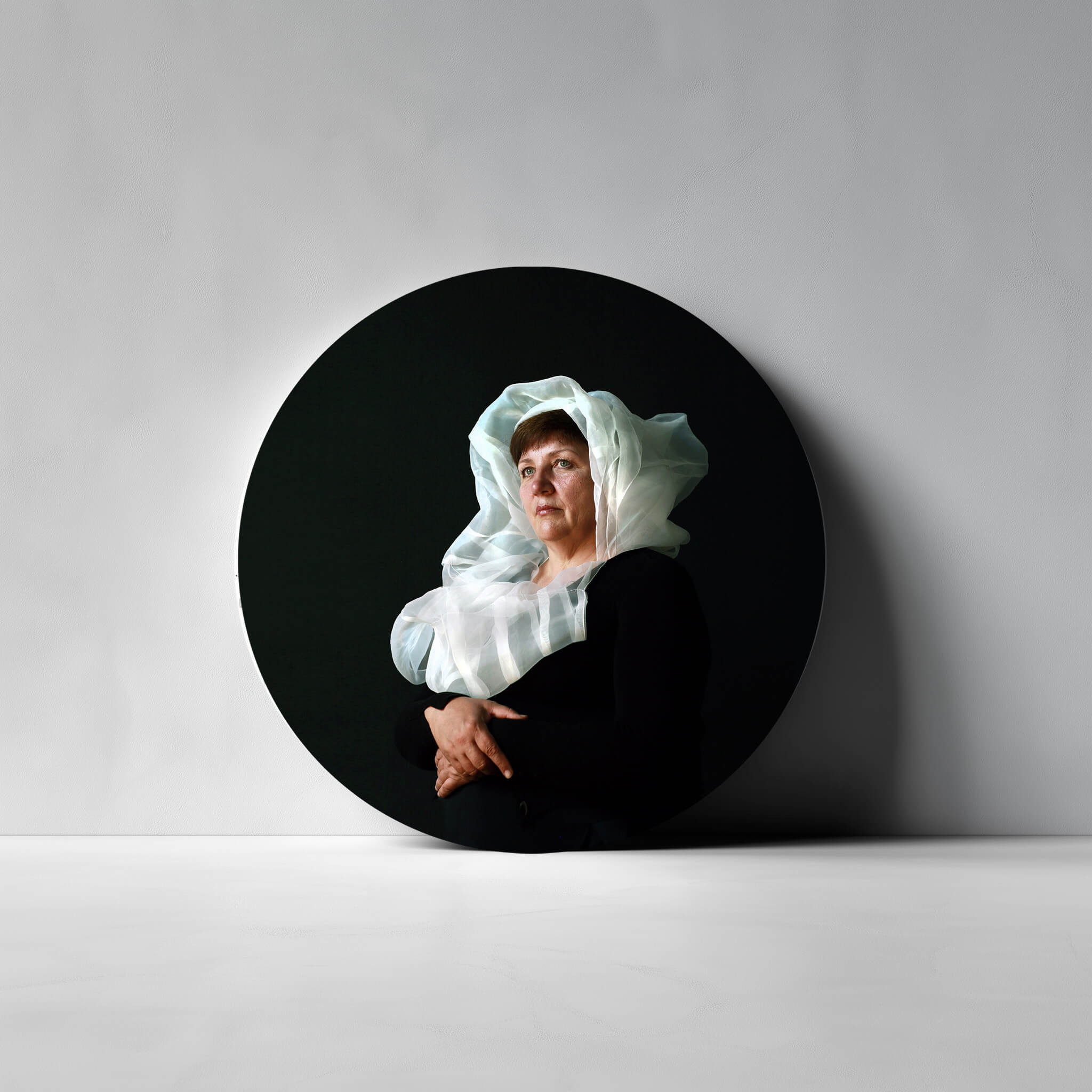
Archetype Archives is not a collection of costumes or symbolic portraits. It is a visual archive of inner roles.
The Open Studio where it began
The series was born in 2019 during an Open Studio in Cologne.
I invited visitors to the studio to take a place in front of my photo background. I had prepared antique and vintage dresses, fabrics, and visual elements. These were not costumes in the theatrical sense. They were materials of transformation.
Most of the visitors had not come to be photographed in this way. They were simply there, in the studio, standing in front of me as themselves.
Often, an association arrived almost immediately. A visitor’s posture, expression or way of occupying the room suggested a figure: The Guardian, The Oracle, The Rose.
I treated that first impression as a starting point for the portrait. Through fabric, gesture and framing, I explored what the association might become.
Not forever. Not as a fixed identity. But in that moment, in that season, in the energy they carried when they entered the room.
I could sense whether the person needed the softness of The Rose, the protection of The Guardian, the knowing of The Oracle, the threshold of The Becoming, the creative force of The Creator, or the deep holding power of The Matriarch.
The entire process took about fifteen minutes per visitor.
I dressed them. I placed them. I watched how their body changed when the right visual language touched them. I photographed them quickly, almost instinctively. There was no long explanation. No elaborate production. No psychological questionnaire.
Just seeing.
And the result shocked me.
When the image knows more than the words
Some works arrive before the words are ready.
On a physical level, I knew exactly what I was doing. I knew which fabric belonged to which person, which gesture needed to be protected, which mood had to remain quiet, which face needed to turn toward the camera, which image would create calm, which one would create confrontation, which one would transform the viewer through stillness.
On a sensory level, I knew it too. I could feel what each portrait had to do. I knew whether the image needed to soothe, awaken, dignify, reveal, protect, or return something to the person looking at it.
On a spiritual level, I also knew.
But I did not yet have the words.
I could make the work, but I could not fully explain the work. I could feel its transforming power, but I could not yet build the language around it.
For years, this series lived ahead of my vocabulary.
Once Upon a Time, The Revelation, Archetype Archives
I gave the series names twice before I arrived at Archetype Archives.
At one point, it was called Once Upon a Time. That name held the fairy-tale element, the sense of story, dress, transformation, and hidden identity.
Later, it became The Revelation. That name came closer. It understood that the work was about unveiling something. Not inventing a person, but revealing a figure that had already been there.
But neither name held all the layers.
In 2025, I finally found the right words.
For the first time, the name could hold the psychology, the history, the aesthetics, and the long-term nature of the project.
Archetype, because the works are about inner figures and recurring human patterns.
Archives, because the project is not a moment. It is an ongoing body of work. A collection of presences. A record of the many selves we inhabit, inherit, resist, and return to.
The Revelation exhibition
In 2019, I created a private Revelation exhibition for the close circle of the first studio visitors.
The artworks were veiled.
One by one, they were opened.
It felt ceremonial because it had to be. These portraits were not casual photographs. They carried something vulnerable and charged. They showed people to themselves through a language they had not necessarily chosen consciously, but recognised immediately.
One of the models saw her portrait and was moved to tears. I had to hug her.
That moment stayed with me.
Because it showed me that the work was not only about how others saw the portrait. It was also about what the sitter recognised in themselves.
The image had touched something before words could organise it.
That is the power I still trust most.
The Divine Feminine and Artists to Watch
Some of the works from this body of work were later selected for The Divine Feminine exhibition by the Mediterranean House of Photography in Barcelona.
That was meaningful to me, especially because the exhibition ran in parallel to one connected to Helmut Newton, one of the artists I had admired deeply during my student years. To have my work placed in that wider atmosphere of photography, femininity, power, and image was a strange and beautiful full-circle moment.
Other works were selected for the book Artists to Watch.
These confirmations mattered.
But they were not the origin of the work.
The origin was still the studio. The first glance. The antique dresses. The visitor who did not know what would happen. The fifteen minutes. The face. The image that knew more than I could explain.
The inner figures we live with
The current Archetype Archives world includes figures such as The Creator, The Matriarch, The Oracle, The Rose, The Becoming, and The Guardian and many more. At the time of writing, I have photographed 33 people for the series.
Each one is an inner figure we may live with at different times. The Creator is the self that begins before permission arrives. The Matriarch is the self that holds life, structure, care, continuity, and responsibility. The Oracle is the self that knows before the mind can prove it. The Rose is the self that remains open without surrendering dignity. The Becoming is the self between worlds, no longer what it was and not yet fully what it will be. The Guardian is the self that protects what is sacred, private, fragile, or future-facing.
These figures are not fixed identities. They are living positions. They move through us. Sometimes one leads. Sometimes one disappears. Sometimes one is wounded. Sometimes one returns when life demands it.
This is why the series keeps growing. Because human beings keep becoming.
Living with an archetypal portrait
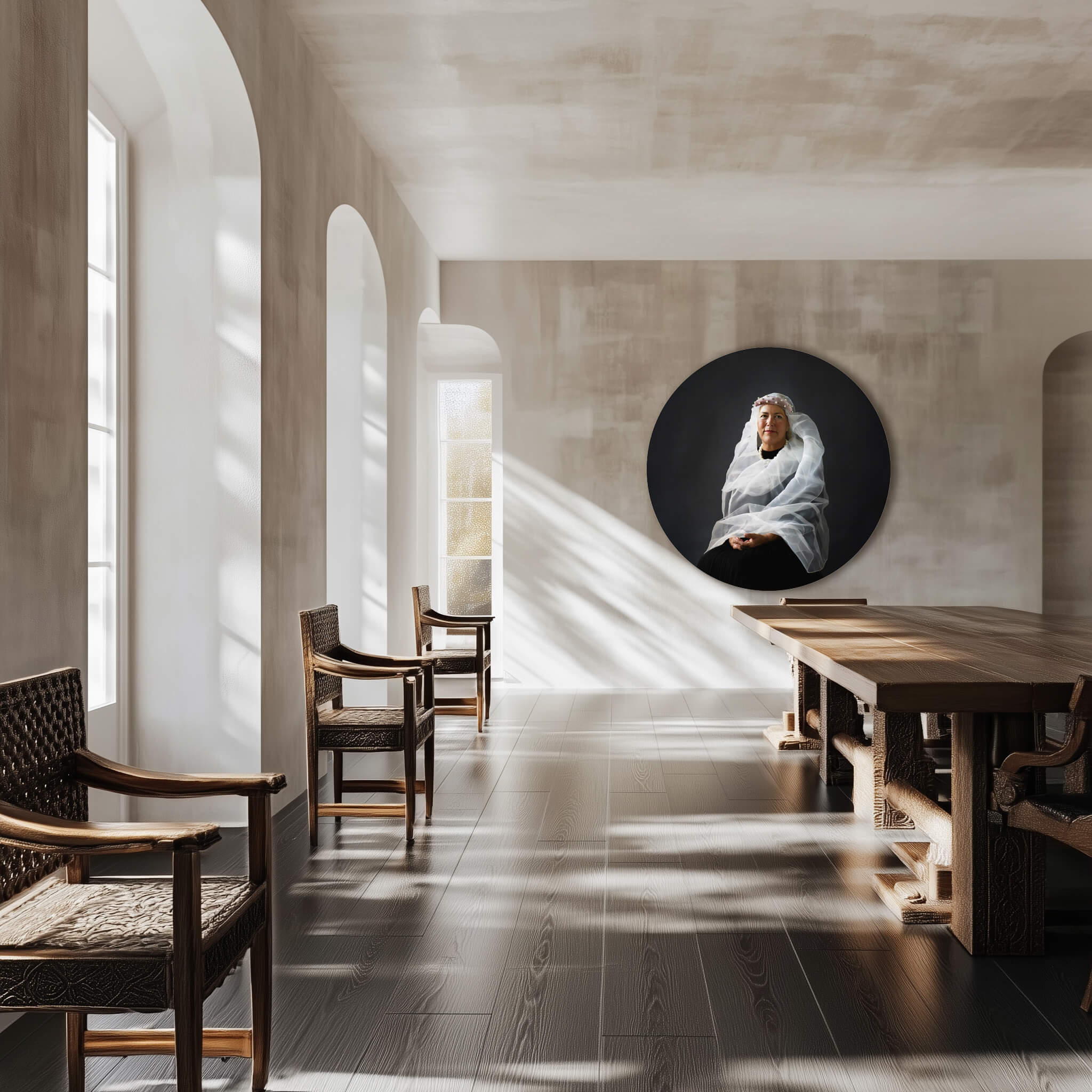
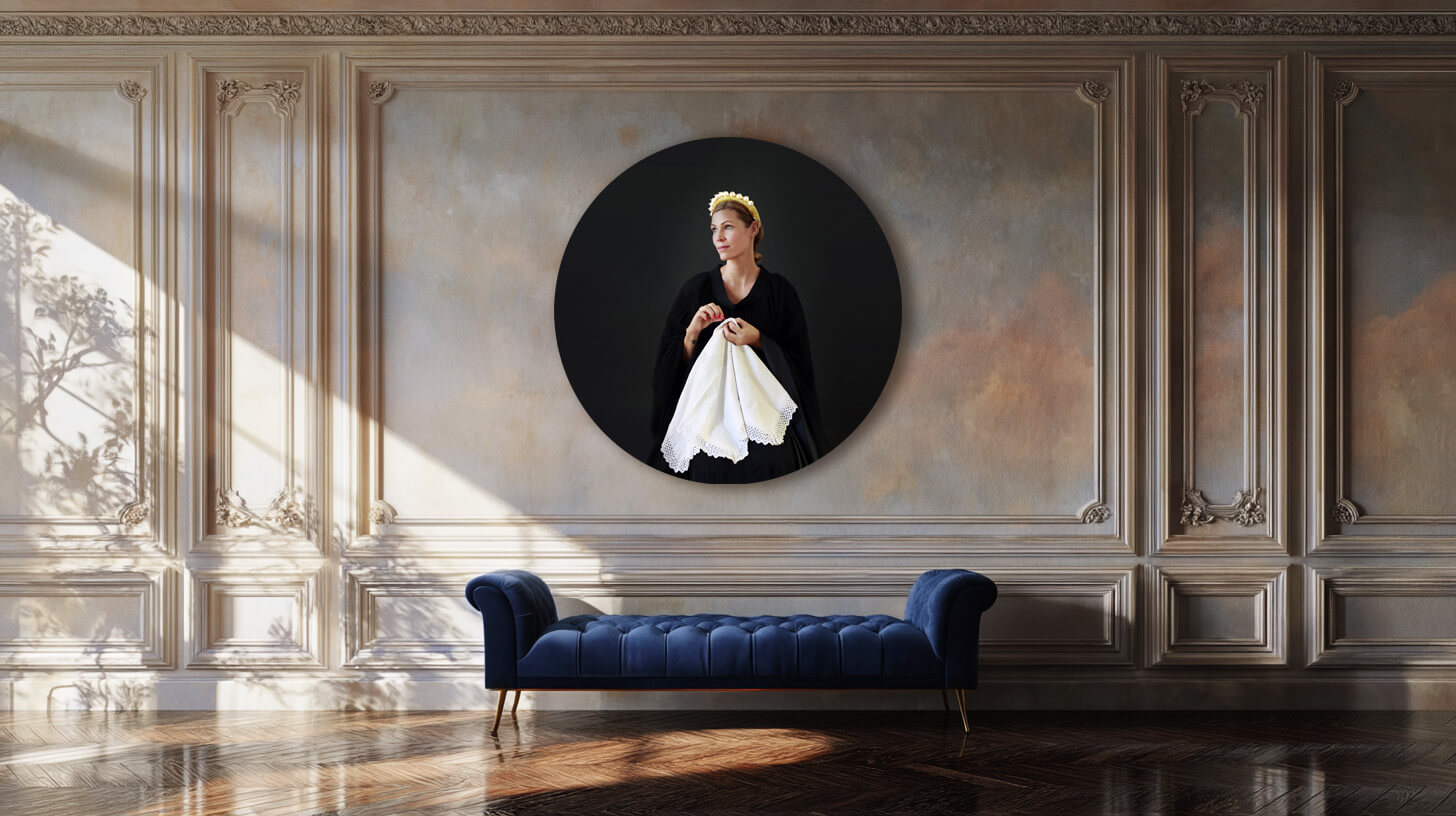
A portrait changes the experience of a room by introducing another human presence. The direction of a gaze, the scale of a face and the distance from which it is encountered all become part of the work.
Within Archetype Archives, the names offer another point of entry. The Guardian suggests protection; The Becoming opens a question about transition. These associations remain available to interpretation. What a figure means to me may differ from what it comes to mean to someone who lives with it.
That is one of the possibilities of collecting a portrait of someone you have never met. The sitter’s image enters your daily life, and familiarity develops without biography being fully known.
An archive that remains open
In 2019, I could make these images before I could adequately explain them. Finding the name Archetype Archives in 2025 helped me recognise the continuity of the project: an enquiry into the roles we inhabit, inherit, resist and revise.
The title also leaves room for contradiction. Care can coexist with authority. Protection can become constraint. An expression that initially appears assured may, on another viewing, seem vulnerable.
I want the portraits to retain that complexity. An image can become familiar and still surprise us.
Choosing a work
Begin with the portrait that holds your attention before you read its title. Notice the gesture, the meeting of figure and ornament, the balance between intimacy and distance. Then return to the name. Does it sharpen your response, or complicate it?
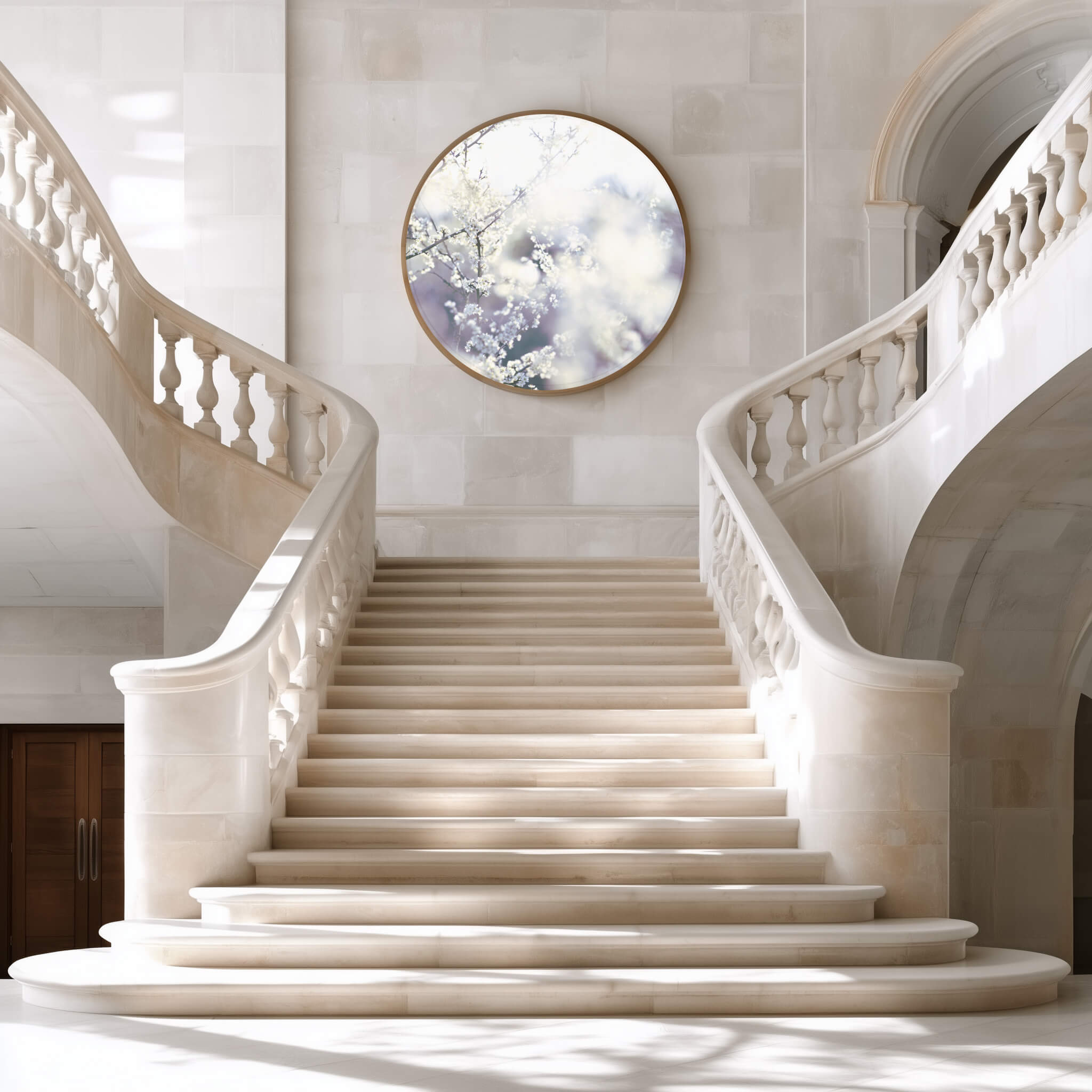
Consider how you will encounter the work in your own space: across a room, beside a reading chair, or at close range as you pass. Scale, light and presentation help determine the character of that encounter.
You do not need to identify yourself with an archetype to collect the work. Curiosity is a sufficient beginning.
Explore available works from Archetype Archives
For current availability, edition details, dimensions and presentation options, contact my studio with the title of the work that interests you. If you are considering a particular setting, you are welcome to include a photograph of the space.
Further encounters
For those interested in becoming part of the image-making process, a personal portrait enquiry begins with a conversation about intention and approach.
Explore the Portrait Experience
Portrait Letter Club, planned for January 2027, will offer another way to encounter this world through printed images and personal correspondence.
The series began with my effort to understand faces in unfamiliar places. It continues through encounters I could never have anticipated—including those between the finished work and the people who choose to live with it.
Before I could trust words, I learned to read faces. Archetype Archives grew from that attention into a photographic portrait series exploring identity, symbolism and the roles we inhabit. A personal essay on its origins, visual language and the experience of living with the work.