

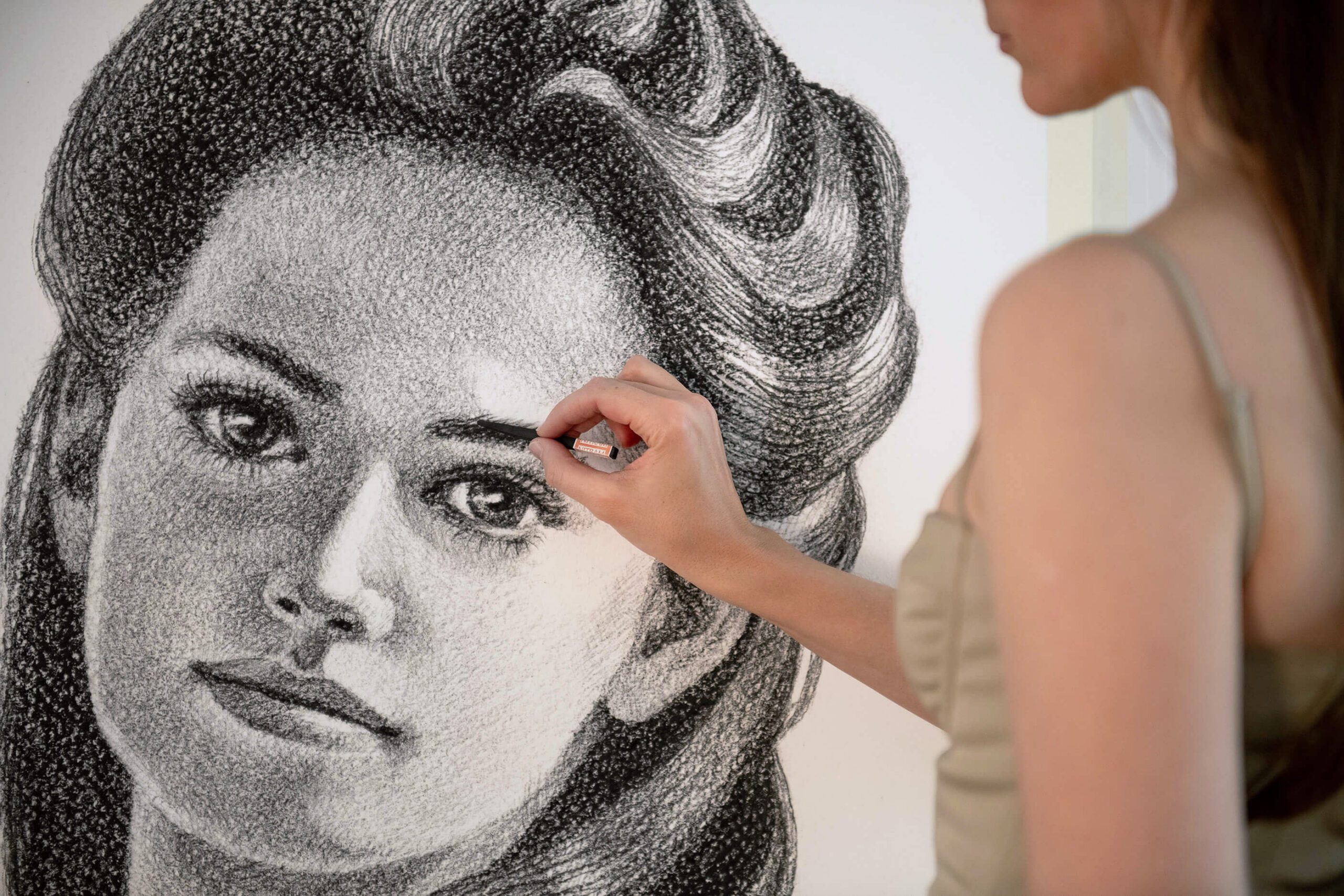
On likeness, consent and the productive limits of controlling one’s image.
By Atlanta Weiss
Imagine a passport photograph and a painted portrait arriving at the same border. The photograph is accepted because it satisfies a standard. The portrait is rejected because it interprets.
In that imagined rejection lies one of portraiture’s most important freedoms.
A passport photograph must make a person identifiable to an administrative system. A portrait can ask what identification leaves out. The two images may depict the same face, yet organise an encounter with that face around radically different purposes.
This distinction becomes consequential when commissioning a portrait. A collector may arrive with a reasonable wish: to be represented accurately. But accuracy is not a single criterion. Anatomical resemblance, recognisable manner, social position and the experience of another person’s presence can coincide. They can also conflict.
My proposition is that a serious portrait needs room for that conflict. When every pictorial decision is subordinated to the sitter’s preferred public identity, the commission risks becoming a branding exercise whose medium happens to be paint.
Recognition and interpretation
Personal branding, as I use the term here, is the deliberate organisation of public signals towards a desired professional identity. It has legitimate purposes. A coherent public image can help people understand someone’s role, work and commitments.
Portraiture can operate within that purpose. It need not be confined to it.
Consider Picasso’s Gertrude Stein of 1905–06. The Metropolitan Museum of Art describes the simplification of Stein’s body and the mask-like treatment of her face, relating the latter to Iberian sculpture. This is a useful instance of likeness being mediated by a developing pictorial language. The Met: collection record.
My reading concerns the work’s formal decisions: the weight of the seated figure, the relationship between face and body, and the refusal to make naturalistic description the sole organising principle. The painting represents Stein while also pursuing problems that belong to painting.
That example cannot establish that distortion produces significance, or that a sitter should accept whatever an artist delivers. It does establish a question worth bringing to a commission: what can the work investigate beyond the successful reproduction of an approved appearance?
The ethics of being interpreted
The artist’s interpretive freedom does not eliminate the sitter’s agency. A commission involves money, expectation, exposure and, sometimes, considerable vulnerability. Romantic claims about artistic truth can conceal an ordinary failure to listen.
I would therefore distinguish three decisions at the beginning of a commission.
The first concerns purpose: why this portrait, at this moment, for these viewers? A private family work and a public institutional portrait have different obligations.
The second concerns boundaries: what may be depicted, discussed or circulated? Agreement to sit for a portrait should not be treated as agreement to make every aspect of the encounter public.
The third concerns authorship: which decisions are being entrusted to the artist? Composition, handling, scale and the relationship between detail and omission need an intelligible space for judgement.
These questions should be settled through explicit conversation and a clear commission agreement. They are the conditions under which artistic uncertainty becomes responsible rather than arbitrary.
Beauty is not the problem
An objection follows: why should a portrait challenge its sitter at all? Is a work less serious because it is beautiful, affirming or loved by the person who commissioned it?
No. Discomfort is not a certificate of quality. Neither austerity nor unflattering representation guarantees insight. A tender portrait can be more exacting than a deliberately abrasive one.
The issue is whether affirmation remains a possible outcome or becomes a compulsory instruction. If a portrait must confirm every claim a person already makes about themselves, it has little room to discover a different visual relation.
Discovery need not involve psychological revelation. A painter cannot prove a person’s inner truth by arranging colour. What the work can offer is a considered interpretation: a particular encounter given material form, open to discussion and capable of exceeding its original brief.
A portrait’s future viewers
A public image is often organised around present usefulness. A portrait may continue to be encountered after the role, reputation or institution surrounding its sitter has changed.
This possibility alters the commissioning question. Instead of asking only, “Does this communicate who I am?”, one might also ask, “What will remain available to someone who does not know my title, achievements or preferred account of myself?”
A hand may become more important than an insignia. The distance between the figure and the edge of the canvas may carry more than a biographical explanation. The work needs enough visual substance to meet viewers who cannot supply its original context.
No artist can guarantee that future attention. Nor does commissioning a portrait secure a place in cultural memory. What can be chosen is the quality of the present encounter: its attention, its honesty about purpose, and the freedom allowed to the image.
The most consequential thing a collector brings to a portrait may therefore be a carefully bounded willingness to be interpreted.
Considering a portrait commission? Explore the Portrait Experience, including the process, confidentiality and starting fees. The first conversation can begin with what the work should be free to discover.
Let’s connect on LinkedIn.
On likeness, consent and the productive limits of controlling one’s image. By Atlanta Weiss Imagine a passport photograph and a painted portrait arriving at the same border. The photograph is accepted because it satisfies a standard. The portrait is rejected because it interprets. In that imagined rejection lies one of portraiture’s most important freedoms. A […]